
ASC 805 Disclosure Requirements
Under ASC 805 disclosure requirements, a buyer reports what it acquired, what it paid and how it allocated the price. Dimov prepares the purchase price allocation (PPA) first, then drafts the footnote from it.
Share the deal size and closing date, and a Dimov CPA replies with a scope, a timeline and a quote.
Call (866) 681-2140 with questions about the deal's accounting.
- 3000+ five star reviews
- Trusted in 27 countries
- All 50 States
What is ASC 805
ASC 805 is Accounting Standards Codification 805, the FASB topic on accounting for business combinations, the deals in which a buyer gains control of a business.
The buyer records assets acquired and liabilities assumed at fair value on the acquisition date, with exceptions such as customer contract balances under ASC 606. In a simple purchase of 100% with no previously held interest, goodwill is the amount paid above the identifiable net assets recognized.
ASC 805 disclosure requirements checklist
For each material business combination, a buyer applies the ASC 805 disclosure requirements relevant to its transaction and reporting entity:
| Disclosure | What the buyer discloses | ASC paragraph |
|---|---|---|
| Deal basics | Acquiree name and description, acquisition date, voting interest acquired, reasons for the deal and how the buyer obtained control | 805-10-50-2(a) to (d) |
| Consideration | Fair value at the acquisition date of total consideration and of each major class: cash, other assets, liabilities, equity | 805-30-50-1 |
| Contingent consideration | Amount recognized, the arrangement and its basis, and the undiscounted range of outcomes or why the buyer cannot estimate one | 805-30-50-1 |
| Assets and liabilities | Amounts for each major class, receivables at fair value and gross, the part the buyer does not expect to collect, and each contingency's nature, amount and basis | 805-20-50-1 |
| Goodwill | The factors behind it, the amount the buyer expects to deduct for tax and, for segment reporters, goodwill by segment | 805-30-50-1 |
| Bargain purchase | The gain, its income statement line and why the buyer paid less than the fair value of the net assets | 805-30-50-1(f) |
Buyers also disclose:
| Disclosure | What the buyer discloses | ASC paragraph |
|---|---|---|
| Acquisition costs | Costs incurred, the amount expensed and its income statement line, plus issuance costs not expensed and how the buyer recognized them | 805-10-50-2(f) |
| Provisional amounts | Why the accounting is incomplete, which items are provisional, and the nature and amount of each adjustment, including income effects from earlier periods | 805-20-50-4A |
| Pro forma, public entities only | Acquiree results since acquisition, and combined revenue and earnings as if the buyer had acquired it at the start of the current annual period, or the prior one with comparatives | 805-10-50-2(h) |
| Pro forma adjustments, public entities only | Nature and amount of material nonrecurring adjustments, or why the information is impracticable to provide | 805-10-50-2(h) |
Buyers with noncontrolling interests, staged purchases or later earnout changes make further disclosures. The buyer gets a measurement period of up to one year from the acquisition date to finalize provisional amounts. The buyer closes the period early on getting the information or learning the information is unavailable.
Purchase price allocation example
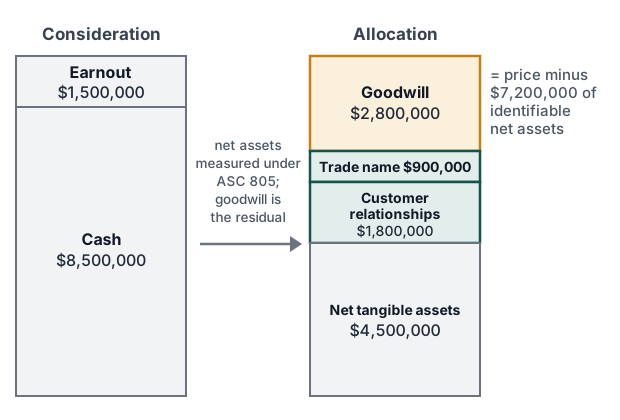
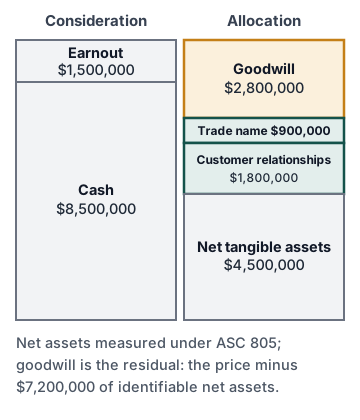
A buyer pays $8,500,000 in cash and records an earnout as contingent consideration at its $1,500,000 fair value on the acquisition date, for $10,000,000 to allocate:
Net tangible assets. $4,500,000, at fair value.
Customer relationships. $1,800,000, from the PPA valuation.
Trade name. $900,000, from the same valuation.
Goodwill. $2,800,000: the $10,000,000 price minus $7,200,000 of identifiable net assets.
Assumes a simple purchase of 100%, no previously held interest and no deferred taxes on the intangibles.
Have Dimov value the intangibles in the deal.
Asset acquisition vs business combination
Screen test for a business
The acquired set is not a business when substantially all of the gross assets' fair value is concentrated in one identifiable asset or a group of similar assets. The buyer counts a building bought with leases in place as one asset. When the value is spread across dissimilar assets, the buyer tests whether the set includes at least an input and a substantive process.
Asset acquisitions under ASC 805-50
The buyer allocates cost, including transaction costs, on relative fair values and records no goodwill.
Purchase price allocation services
Opening balance sheet
Dimov prepares the buyer's acquisition accounting at fair value on the acquisition date, the day the buyer obtains control, and applies the standard's exceptions.
ASC 805 valuation
Dimov values intangibles such as customer relationships, trade names and technology, using income, market or cost approaches.
Business combination footnote
Dimov drafts the business combination note against the ASC 805 disclosure requirements and updates it through the measurement period.
Tax basis and Form 8594
Dimov maps book values to the tax side, including 15-year amortization of qualifying section 197 intangibles and the asset allocation on Form 8594 in an asset deal.
Purchase price allocation cost
Dimov bases the quote on:
Intangibles. Dimov values each intangible separately.
Earnouts. Dimov values an earnout classified as a liability at the acquisition date and at each later reporting date.
Target books. Dimov adds a cleanup fee when the target has not reconciled its books.
Acquisition accounting help
Senior Dimov staff assess the acquisition accounting on a 30 or 60 minute call and put unused time toward later work.
Ask for a call on the acquisition accounting.

Reviewed by George Dimov, CPA. Certified to practice in all 50 states. 15+ years advising on business tax, including M&A. Read George's bio.