
IRS Form 8300 instructions
- 3000+ five star reviews
- Trusted in 27 countries
- All 50 States
When a business must report cash
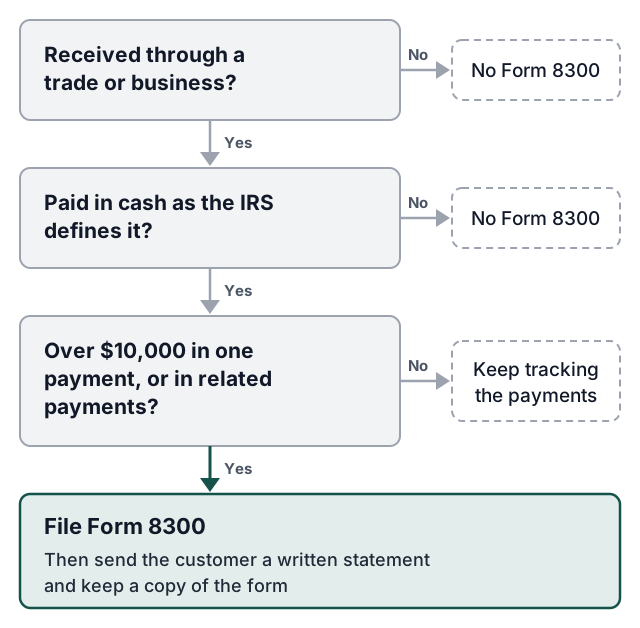
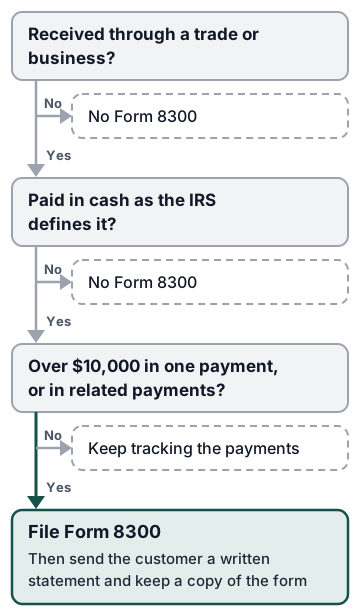
A business that receives over $10,000 in cash, including some cashier's checks and money orders, in one transaction or related ones files Form 8300.
The business files within 15 days of receiving more than $10,000, or the next business day if day 15 is a weekend or holiday.
The business sends each person named on a required form a written statement by January 31 of the next year.
Send us one recent large cash sale and the cash log. We reply with what to file, by when, and anything already late.
Form 8300 filing services
Cash tracking by buyer
We flag related payments while the filing deadline is still open.
Form preparation and e-filing
We complete Parts I to IV and file through BSA E-Filing.
Customer statements
We send each statement with the details the IRS requires.
Sales desk checklist
We turn the 8300 form instructions into a one page checklist for staff.
Late and corrected forms
We file the forms the business missed, amend the wrong ones and keep a record of each fix.
IRS letters and exams
We reply to the IRS with the sale records, forms and ID notes behind each filing.
What is Form 8300 used for
2
agencies, one filing
Congress requires the report so the IRS and the Financial Crimes Enforcement Network (FinCEN) can trace money from criminal activity and support criminal, tax and terrorism investigations.
The IRS prints both agency names on the Form 8300 PDF, so the same form is IRS Form 8300 and FinCEN Form 8300.
Form 8300 requirements
Any person in a trade or business can owe the form, including a sole proprietor, partnership, trust or estate. An individual selling a family car outside any business files nothing.
In Publication 1544, the IRS sorts payments by type:
Always cash.
US and foreign coins and currency.
Cash in some sales.
A cashier's check, bank draft, traveler's check or money order of $10,000 or less. The business counts it as cash in a retail sale over $10,000 of a car, boat or other consumer durable, a collectible, or a trip or event. The exceptions are documented bank loan proceeds and some installment and down payment plans. The business also treats the instrument as cash when it knows the buyer is using it to avoid the report.
Not cash.
A personal check drawn on the buyer's own account, or a cashier's check, bank draft, traveler's check or money order over $10,000.
Example, with no loan or payment plan exception:
A buyer pays $5,000 in currency and a $9,000 cashier's check toward a $30,000 car.
The business counts both, for $14,000 in cash.
The total is over $10,000, so the business files Form 8300.
Form 8300 rules for related payments
A business adds one buyer's cash payments together:
Within 24 hours. The business adds each payment from the same buyer within any 24 hour window, even across separate sales.
Connected deals. The business also adds payments further apart when it knows, or has reason to know, the payments are part of one series.
Installments. The business adds payments made within one year of the first and files once it has received more than $10,000. After each filing it starts a new count, and files again when it receives more than $10,000 within 12 months.
Splitting payments to avoid Form 8300
A buyer who breaks one purchase into smaller cash payments to stay under the threshold commits structuring, a federal crime, and so does any business that helps.

…there's a possibility of some type of a rule that's broken, we immediately disengage… It's just not a side of anything that I want to be involved in.
How to file Form 8300
The business follows the IRS regulations in this order:
Identify the payer.
The business lists the individual who hands over the cash in Part I, and any person or company that individual pays for in Part II.
Collect the TIN and check ID.
The business records each name, address and taxpayer identification number (TIN), then checks the individual's ID, such as a driver's license or passport.
File it.
A business required to file at least 10 other information returns during the calendar year must e-file through FinCEN's free BSA E-Filing System, unless it has a waiver or exemption. Other businesses can e-file or mail the form.
Keep the record.
The business keeps a copy of each form for 5 years from the filing date.
Penalties for late or wrong forms
The IRS can charge up to $340 for each late or wrong form due in 2026 or 2027, and $340 for each customer statement the business fails to send.
For intentional disregard, the IRS can charge, for each form, the greater of a set minimum or the cash received, up to a cap, with no yearly limit:
Send the sale date and anything already filed, and we reply with the steps to correct it.
IRS cash reporting audits
For a car dealer's Form 8300 exam, the IRS says examiners typically ask for:
Bank statements and deposit slips for each business account
A deposit reconciliation with each receipt's amount, date, payment method, payer and receipt number
Sale and lease files for the exam period
Sales journals, cash receipts journals, receivables and sales invoices
What happens if a Form 8300 is filed on you
You have nothing to file. For a required filing, the business that took your cash sends you a written statement.
The business lists its contact details and the cash it reported to the IRS for you that year. A business that files voluntarily because it found a payment suspicious sends no statement.
Keep proof of the cash's source, such as bank withdrawal slips or a sale agreement.
If the IRS asks about the cash, send us the letter and the statement, and our IRS audit representation team answers it.

What cash reporting help costs
We price against:
Cash sales. How many reportable cash sales the business takes each year.
Past forms. Whether the business missed earlier forms or filed them late or wrong.
IRS contact. Whether the IRS has already sent a letter or opened an exam.
Related services for cash businesses


Send us your cash log and past filings
Include any IRS letter. We flag what is missing or late before we start, then file from the next cash sale.
We reply within 24 hours and keep the details confidential. Call (866) 681-2140.
Reviewed by George Dimov, CPA. Serving clients nationwide. 15+ years advising on business tax and accounting.